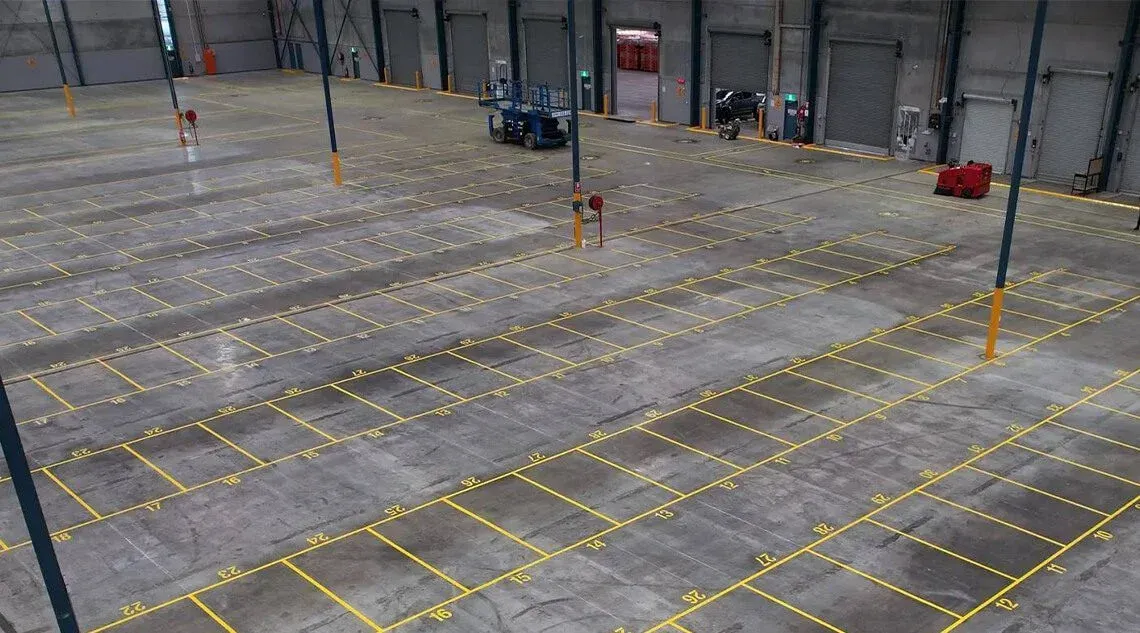
A Work Health and Safety (WHS) audit in a Sydney warehouse can be scheduled or unannounced. In either case, floor line marking is among the first things an inspector assesses when entering the facility. Clear, compliant line marking is one of the most visible indicators of how seriously a business takes its safety obligations, and it is one of the areas most frequently cited in SafeWork NSW improvement notices issued to warehouses across Greater Sydney.
This guide outlines the line marking requirements that apply to warehouses under the Work Health and Safety Act 2011 (NSW), the practical steps needed to get a facility audit-ready, and when professional warehouse line marking is the right call.
What WHS Auditors Look for in a Sydney Warehouse SafeWork NSW inspectors who attend warehouses are guided by the model WHS Regulations and the code of practice for managing the risks of plant in the workplace. Line marking is specifically referenced in relation to:
• Separation of pedestrian and forklift traffic paths • Identification of hazardous zones and restricted areas • Emergency egress and exit path marking • Safe storage zone delineation and racking clearances
An inspector will typically walk the full facility and assess whether all work areas, pedestrian paths, hazard zones, and emergency routes are clearly and durably marked, and whether those markings are still legible and in good condition. Faded or worn line marking is treated as non-compliant. A line that is no longer visible does not function as a hazard control, regardless of whether it was once correctly applied.
Pedestrian Walkway Marking Pedestrian walkways are required wherever workers on foot share a space with forklifts or other mobile plant. Under the WHS Regulations and the associated code of practice for workplace traffic management, walkways must be:
• Clearly marked with continuous solid lines (typically white or yellow, minimum 100mm wide) • Wide enough to accommodate the workers who use them (a minimum of 600mm clearance per person for light foot traffic) • Kept free of obstruction, including stored goods, cables, and equipment • Marked at all intersections with forklift traffic paths to indicate priority and stop points
Where a pedestrian walkway crosses a forklift aisle, the crossing must be marked with a pedestrian crossing treatment, including stop lines or a hazard chevron pattern, to alert forklift operators to the crossing point.
Forklift Traffic Zone Marking Forklift operating areas must be clearly distinguished from pedestrian zones. The standard approach in Sydney warehouses includes:
• Yellow lines defining the forklift travel aisle (minimum 100mm wide, with aisle width determined by the turning radius of the forklift model in use and any clearance requirements under the relevant code of practice) • Yellow boundary lines around forklift parking and charging areas • "FORKLIFT ZONE" or "NO PEDESTRIANS" stencil text in designated areas • Directional arrows within forklift aisles to establish one-way traffic where required by layout
Where speed humps or anti-slip surface treatments are installed within forklift zones, line marking must be coordinated with these features to preserve their visibility and function.
Hazard and Caution Zone Marking Hazard zones around high-risk equipment, electrical switchboards, loading dock edges, and machine guarding areas require specific marking treatments. The standard colours used in Australian warehouse environments are:
• Yellow and black diagonal stripes: Used for hazard borders around fixed equipment, edges of elevated work platforms, and the footprint of floor-mounted machinery • Red: Used to denote fire equipment keep-clear zones, fire lanes, and emergency stop control areas • Green: Used to mark first aid points, safety equipment stations, and emergency assembly area boundaries
Colour choices should be applied consistently throughout the facility and should align with AS 1319 (Safety Signs for the Occupational Environment) to avoid confusion arising from non-standard colour coding.
Emergency Exit and Fire Equipment Zone Marking SafeWork NSW inspectors give close attention to emergency egress marking. In a warehouse environment, the requirements include:
• Keep-clear zones in front of fire hose reels, fire extinguishers, and hydrant booster assemblies (typically marked in red, minimum 500mm clearance each side of the equipment) • No-obstruction zones in front of emergency exit doors, marked with diagonal hatching to indicate the area must be kept clear at all times • Floor-level emergency exit arrows in facilities where smoke may obscure wall-mounted signage
These markings must be maintained in a legible condition at all times. An emergency exit path partially obscured by pallet racking, or a fire extinguisher keep-clear zone being used for temporary storage, will result in an improvement notice. In cases where the risk is assessed as immediate, a prohibition notice and partial site closure can follow.
Storage Bay and Racking Zone Delineation In warehouses where goods are stored on pallets or in racking, storage bay outlines on the floor prevent goods from being placed in access aisles or encroaching on safety clearance zones. Bay outlines are typically marked in white or yellow and define:
• The floor footprint of each racking run or storage zone • Safe clearance zones around racking uprights • Forklift access paths to each bay
Clearly marked storage zones also make it easier to maintain consistent housekeeping standards and demonstrate to a WHS auditor that the facility is being managed in a systematic way.
Paint Type for Warehouse Line Marking: Why It Matters The paint product used for warehouse line marking must be appropriate for the surface and the conditions it is exposed to. Concrete warehouse floors subject to forklift traffic require a durable product such as two-pot epoxy or MMA (methyl methacrylate) paint. Water-based products fade quickly under heavy wheeled traffic and are not appropriate as a primary marking solution in an active warehouse environment.
In some warehouses, old line markings that have been painted over repeatedly have built up to a thickness that causes a trip hazard at the edges. In these cases, removal before remarking is necessary. Line marking removal by grinding and shot blasting the concrete surface ensures a clean profile and improves paint adhesion for the new markings. Shot blasting is also used where the existing concrete surface is too smooth for adequate paint adhesion on its own.
How Often Should Warehouse Line Marking Be Reviewed? Line marking in a working warehouse should be assessed at minimum during the annual WHS risk review. In high-traffic forklift aisles and pedestrian crossing zones, markings may need to be refreshed every one to two years. In lower-traffic areas where more durable products have been used, a three to five-year cycle may be appropriate.
Where the warehouse layout has changed, such as racking being relocated, new equipment installed, or aisle widths adjusted, the line marking must be updated to reflect the current layout. Markings that reflect a previous configuration are a compliance risk even when they remain physically visible on the floor.
For facilities going through a staged layout transition, temporary line marking can be used during the changeover period to maintain pedestrian and forklift safety while permanent markings are being planned and scheduled.
What Happens If a WHS Audit Identifies Line Marking Deficiencies?
SafeWork NSW has several tools available when non-compliance is identified: • Improvement notice: The most common outcome for line marking deficiencies, requiring the business to rectify the issue within a defined timeframe (typically 7 to 30 days) • Prohibition notice: Issued where the risk is assessed as immediate; can result in a section of the facility being closed to operation until the hazard is controlled • Penalty infringement notice: Fines of up to $3,600 for an individual or $7,200 for a body corporate for failing to comply with an improvement notice within the required period
In addition to regulatory consequences, a workplace injury occurring in an area that was not correctly marked creates a workers compensation liability and the potential for prosecution under the WHS Act for failing to provide a safe workplace. The cost of correct line marking is a small fraction of the exposure that follows a preventable injury.
Frequently Asked Questions About Warehouse WHS Line Marking
What colour should pedestrian walkways be marked in a warehouse? White and yellow are both used in Australian warehouses. Yellow is the more common choice for pedestrian and forklift separation because of its higher visibility on grey concrete. The important requirement is that the colour choice is consistent throughout the facility and clearly distinguishable from other marking categories.
Do all aisles in the warehouse need to be marked? Any aisle where forklifts operate must include a clearly marked travel path with separation from pedestrian zones. Storage aisles that are exclusively pedestrian access may also require marking depending on the site-specific risk assessment.
Can warehouse line marking be completed while the facility is operating? Yes, in most cases. City Line Marking works with warehouse and logistics operators to stage the work by zone so that operations continue while each section is being marked. Works can also be scheduled outside operating hours for facilities where staging is not practical.
How long does it take to line mark a warehouse? A typical medium-sized Sydney warehouse of 2,000 to 5,000 sqm with standard pedestrian walkways, forklift zones, and hazard markings can generally be completed over one to two days, including surface preparation. Larger or more complex facilities may require a staged programme across multiple days or shifts.
Get Your Sydney Warehouse WHS-Ready with Professional Line Marking City Line Marking delivers warehouse line marking services across Sydney that are designed to meet SafeWork NSW requirements and hold up to the demands of an active distribution or manufacturing environment.
From pedestrian walkways and forklift traffic zones through to emergency exit markings, fire equipment keep-clear zones, and storage bay delineation, the full range of warehouse safety marking needs is addressed. Projects are planned around operational requirements to minimise downtime and disruption.
Contact City Line Marking today for a free site assessment and written quote.